
This is the third post in our Co-op on a Budget series, which explores the different ways that we can shop co-op effectively and affordably. Also check out the first post, on shopping bulk and the second post, on the Wedge Co-op vs. Cub Foods.
I shop almost exclusively at the Eastside Food Co-op for my family of four, but some of my friends and neighbors shop elsewhere. They say they feel the co-op is too expensive, or that its selection is limited. Other stores they shop at include Target, Rainbow, Byerly's, Cub, Whole Foods, and Trader Joe's. I wanted to put the price and selection prejudices to the test. Is EFC really more expensive for a weekly shopping trip? Can a family find everything it needs in one store?
I chose Rainbow
Foods, the closest grocery
store, as my comparison. I made a sample grocery list of 14 basic items, and then
shopped each store. Still, making an apples to apples comparison is hard. I
favored local, organic items, but I was only able to compare the exact same
item in one case. Rainbow does have organic sections throughout the store, so I
compared a few of these organic items – lettuce, milk, mac and cheese, and
frozen blueberries. For other items, like bread and eggs, I chose the least
expensive conventional item at Rainbow, to see if buying conventional eggs and
bread resulted in savings that were significant enough to justify the
difference in quality. While I admit a bias in favor of EFC*, I did not fiddle
with the numbers to get the result I wanted. I shopped both stores, noted
prices, entered them in the spreadsheet, hit total, and these are the results:
|
Item |
EFC |
Rainbow |
|
Lettuce |
1.99 |
3.49 |
|
Cuties |
1.99 |
1.59 |
|
Cheddar Cheese |
5.39 |
4.99 |
|
Eggs |
3.39 |
1.99 |
|
Milk |
4.59 |
5.99 |
|
Crackers |
2.79 |
4.19 |
|
Mac and Cheese |
1.59 |
1.79 |
|
Roast Chicken |
7.99 |
5.99 |
|
Bread |
3.99 |
2.49 |
|
Cereal |
3.89 |
5.29 |
|
Spaghetti |
2.59 |
1.73 |
|
Diced tomatoes |
1.19 |
1.39 |
|
Frozen blueberries |
2.99 |
4.99 |
|
Frozen peas |
2.89 |
2.19 |
|
TOTAL |
47.26 |
48.1 |
Of the 14 items on my list, EFC had all
available in organic or local options; Rainbow did not. Additionally, because
EFC focuses on local, organic options, their prices on these items were often
lower then the organic or even conventional option at Rainbow. Here are the
details behind the numbers.
Lettuce: EFC had organic bright green, crisp heads of romaine
for $1.99 apiece. In Rainbow's organic section, they had a very wilted head of
green leaf lettuce for $3.49.
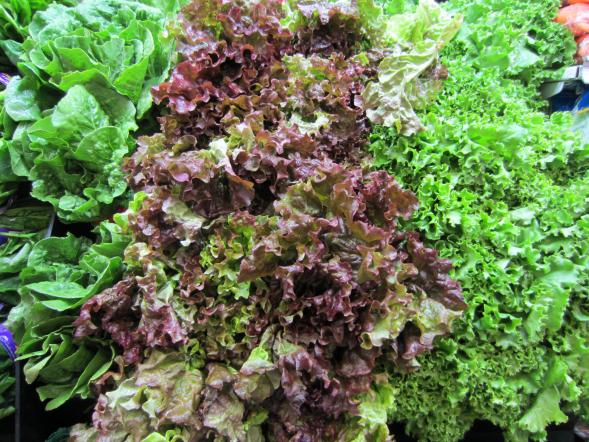
The lettuce at Eastside is so happy to see you it almost leaps into your cart
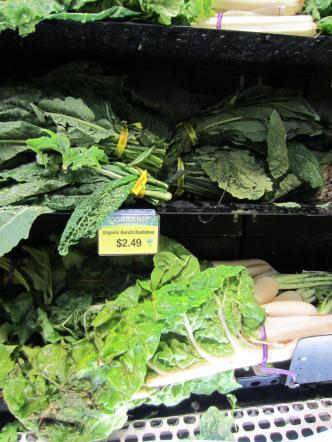
The sad, sad organic greens at Rainbow
Fruit: a pound of organic cuties (seedless mandarin oranges) at EFC was $1.99. At Rainbow, non-organic cuties were $1.59 a pound.
Cheddar cheese: both EFC and Rainbow carry Bongard's, a local cheese
company. EFC's price was $.40 more for the same item.
Eggs: EFC had Larry Schultz's free-range, cage-free,
certified organic Grade A large eggs for $3.39/dozen. Rainbow had their house
brand Roundy's dozen large Grade A conventional eggs for $1.99.
Milk: At EFC, I chose milk that is not certified organic,
though there are several certified organic to choose from. Instead, I chose a
gallon from Valley
View Farms, a local milk
co-operative, most of whose farmers use sustainable, organic practices, at
$4.59. Rainbow's Roundy's organic milk was $5.99 a gallon.
Crackers: At EFC, Kashi crackers were on sale for $2.79 a box.
At Rainbow, Cheez-Its were on sale for $4.19 a box.
Mac and Cheese: At EFC, Back to Nature's local, organic mac and
cheese was $1.59 a box. At Rainbow, the least expensive organic option was
$1.79.
Roast chicken: On Sundays EFC offers a whole local chicken for $7.99. At
Rainbow, a whole roast chicken is $5.99 but not labeled as local or organic.
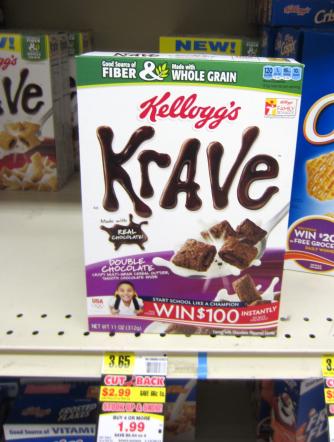
There is no comparable product to this at the co-opBread: At EFC, Rudi's organic whole-wheat bread was $3.99.
At Rainbow, there was a big endcap advertising bread at $1.99 a loaf, but only
if you bought ten. Sara Lee's is not local or organic, and the per-loaf price
was $2.49.
Cereal: At EFC, a 20-ounce box of Mom's Naturals Toasty O's was
$3.89. At Rainbow, a 21.6-ounce box of Cheerio's Honey Nut O's was 5.29.
Spaghetti: At EFC, I chose nearby Dakota Growers for $2.59.
Rainbow had conventional Creamette on sale for $1.73.
Diced Tomatoes: EFC had organic Muir Glen tomatoes on sale for $1.19
a can. Roundy's non-organic were $1.39.
Frozen Blueberries: EFC has Cascadian Farms Organics on sale at $2.99 a
bag, while Roundy's organic were $4.99.
Frozen Peas: EFC had organic peas for $2.89 a bag. Roundy's
non-organic peas were $2.19 a bag.
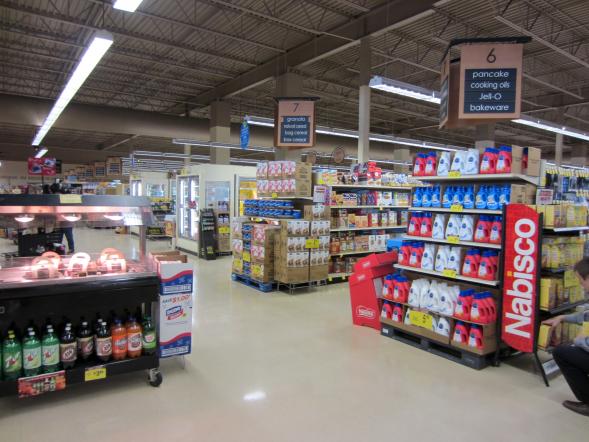
The Rainbow store is huge, so it takes more time to shopBoth stores had all items on my list,
but Rainbow is a larger store, so it took longer to shop (don’t forget time as
a factor in cost). I took advantage of sale items, which made a significant
difference, especially at EFC. With this comparison, I found that EFC is
competitive in its prices, with a superior selection of organic, local options.
It's small but well stocked. I only have to go to one store, which saves time
and gas. I can find everything I need in a small space, so shopping is a quick
event. And if my energetic boys run off, they can't go too far. If you've
avoided shopping entirely at your local co-op because you think it's too
expensive, or that you can't find everything you need, you might want to
reconsider. Take another look at the prices, shop items on sale, and consider
the local, organic advantage.
(Prices compared January 5-7, 2013)
*Disclosure: I am a member of Eastside
Food Co-op, I write for its newsletter, and my husband is the president of its
Board of Directors. It's theoretically possible that if many people went to EFC
as a result of this article, and spent many, many dollars, I might, as a
member, gain an increased dividend down the line. This small, growing co-op has
yet to declare a dividend, though, and I can't imagine it would make more than
a few cents difference. So while I am biased toward the co-op, it's because of
its conscientious business practices, not any potential benefit to myself.

Kristin Boldon is an occasional contributor for Simple, Good, and Tasty. She also writes for the Eastside Food Cooperative's newsletter, Minnesota Monthly's food blog TC Taste , and her own blog Girl Detective. Her last post for us was L.C. Finns Local Extracts: Spice Up Your Holiday Baking.
Comments
If I ever spent almost $50 on 14 basic items, I would just turn in my family-of-4 primary shopper card right there. Who can afford to shop like that? The experienced shoppers I know use a strategy of shopping sales, coupons and generics to feed their family without breaking the bank. The prices above are unrealistic for most families.
Sue, I appreciate your point. In making the comparison I had to make decisions on what to compare. Cheapest possible item to cheapest possible item? Instead I chose a variety of foods and quality to show the range at each store. $50 isn't cheap, but it I don't think it's extravagant, either.
You don't include the amount for most items, so maybe you are getting larger amounts than I am thinking of. But assuming the typical amount, I look at identical items I bought on my shopping trip to Cub yesterday. I got cheddar cheese for $4/lb (store brand), milk for $3.19 (non-organic), 1-lb spaghetti for $1 (on sale), loaf bread for $2.35 (BOGO store coupon), cereal for $2.25 (13-oz box, store brand, sale, + coupon, so would be $3.60 for comparable size). That is, $14.15 for the same items you list at $20.50 above (same amount for both co-op and Rainbow). If I shopped at the co-op prices you cite, or failed to use shopping expertise at Cub, I could be adding 30 percent to my food bill. Not good home economics!
I applaud your topic and your research. Whenever I go into a big box store, I am always surprised when the myth -- "everything is cheaper than the co-op" is destroyed. We shop primarily at co-ops, and exclusively for food items. I do have a membership at costco, but we use it for large volume items like baking soda and hydrogen peroxide. I talked with one of the eastside board members about the costco experience not long ago, about what the draw was. I really had to think. I buy their free and clear laundry soap because it is cheap and fragrance free, that's what I told him. It really got me thinking. Is it really? I'm now buying Country Save powder, which is better for my HE machine and for our neighborhood economy. And, it turns out, it's actually cheaper.
The size of the co-op, compared to the expansiveness of Rainbow is a big part of what makes me spend my food dollars at co-ops. I have chronic health issues, and I know that I can't handle the size and scope of commercial stores, much less the strong smelling cleaners and laundry products. I also know that if I needed support because of my illness, any one of the workers at the co-op, many whose names I know, would know to call my husband and/or help me in any way that I need. That alone, is priceless.
But most importantly, knowing that the products I buy are safe, knowing how they are farmed, butchered, fed is so important to our sustainability and our family's health that we make our food budget the most important part of our budget.
Thanks, Kristin, for reminding me how important our co-ops are!
Thank you for writing this article, Kristin! I've been explaining these same differences to friends who shop organic at the big groceries, too. If you're looking to buy organic and local, there's no other way to go. Rainbow and Cub overprice organics because they're not buying direct and because of the caché. Lund's and Byerly's, too. In fact, they plan their sales to directly compete with the monthly co-op deals, but if you do the math, you're definitely getting a better deal at the co-op, sometimes even at regular price.
More than anything, I appreciate the shopping experience at the co-op. I run into friends and neighbors there, not stressed-out and/or zombified people overwhelmed by the sounds, smells, and visuals of the large groceries. There is an honest community at all of the co-ops and you can often see how those stores positively impact the neighborhoods and communities in which they are located.
I heart co-ops, especially East Side!
It used to be that the EFC was my convenience store, a place to shop where I needed only a few items and could get in and out fast. Now, the conventional grocery store (Cub Foods for me) has become my convenience store. I have to go there often for prescriptions so I'll pick up other things as well, mostly water (reverse osmosis in refill jugs). And now that I know where everything is in that huge, gigantic store i can get in and out fast. EFC has become our primary store for most things except some cuts of meat and prawns. It is good to know that the prices are comparable.
There are plenty of Co-op coupons. I find that shopping at conventional stores with deals and coupons doesn't work for me as I don't buy most of those brands. For me, it's not about getting the cheapest deal, but rather having access to those ingrediants I need.
I really liked your point about how local, because it is local, can be cheaper.
I am always astonished to hear people cutting their food budget when there are others places that could get cut like cell phone and cable. We have never budgeted food in the sense that we will pick up whatever it is that we want to cook. It was surprising how much this works for us because we spend much less on eating out. Now eating out is a treat again.
In terms of the economy, I do believe it is better to pay slightly higher prices for local and organic because in the end those farmers and distributors benefit from my consumption, as opposed to big corporations that provide cell phones, etc. In the end we are better off. And you have clearly shown that buying from a Co-op is not more expensive than going to a conventional store.
Sorry, my comments are all over the place. I like your post!
I agree with J.B. (James Brown, I assume) … the decision to shop at the co-op is based on more than food prices alone. There are a lot of other factors in play here. Not the least of which is supporting your community through neighborhood businesses and local farmers, a much overlooked tactic in keeping our community thriving (and in this instance, healthy!) I also notice that the organic produce at Cub/Rainbow is much less fresh than at the co-op, probably because the demand for a higher priced (and arguably higher quality) food item is low at the larger groceries. Maybe as the priority for healthy eating and living overcomes the quest to save a few dollars then the larger groceries will become competition for the co-ops.
To the editors, you should link this article with the other “Co-Op on a Budget” articles previously written in this series. Maybe I missed it, but I didn’t see a link or any reference to the series on a whole.
What a great show of support for small, sustainable stores and local, organic producers. For the past 15 years, it has been almost impossible for me to imagine prioritizing anything over food. I simply would never compromise good, quality food made without a bunch of added crap for savings of 20-30%. I'm sure that my $400/month food budget could be decreased by $80 or even $120, but what would that do to my level of health? What about my happiness? I guarantee that biting into some cheap mass produced cheese food would not elicit the same grin of delight that a locally made cheese for a few bucks more would. I like what Manisha had to say about other "non-essentials" like cell phone plans or cable tv and I would add retail goods. It's pretty darn easy to save $100/month if you try, without having to eat a bunch of processed junk.
thanks everyone for your participation and comments. and I will add the link to the series. nice catch, Ben.
Sue, as I noted in the article, I didn't buy the absolute cheapest possible item at each store. If I did, I suspect that the price advantage would go to the conventional store, but not by much, and the quality advantage would skew highly to the co-op. I could certainly do that article if readers are interested. I also did not use every smart-shopper trick I could have--I could have saved at least $5 off at the co-op by using coupons and my member discount (a once a month discount of 5% off the entire bill). What I take away from this experiment is that if I shop smart at the co-op, using coupons, discount, sale items, I am getting a much higher quality of food (milk from cows not treated with antibiotics, eggs from chickens who are allowed to range, not get their beaks clipped and live in a tiny box, food not made with genetically modified ingredients), spending money at a local business that carries local food items (so my money stays in the community) plus saving time and money by shopping at one store that's close to my home. For me, Cub is 5.1 miles, while the coop is .7. I can (and often do) walk or bike to the co-op.
Benjamin, good suggestion on linking to all the other budget articles. Let me see if we can do that.
Neither the author nor the comments from Sue address the equally important factor of how we spend money. Along with the issues of where & why to buy food (ulterior reasons), we should be sharing our stories about where & why we spend money overall. I ask of Sue: Why do you feel you need to scour the products at Cub to find the most volume for the cheapest price? Food is too important to our health to put it at the bottom of the list of our expenses. I am not assuming anything when I ask, Are there ways to reprioritize the amount we spend on food versus personal electronics or home furnishings or any other number of things? Spending a bit more on groceries should be recognized for its benefits not for its costliness. Eating healthier food from quality sources will make you feel good, perhaps better, and you most likely will enjoy shopping again instead of begrudging the task.
True … not to mention the inevitable money saved through good health and clean foods. I’d love to see a study that could analyze the end-of-life cost savings of reduced medical bills (prescription medications, hospitalizations, specialist consultations) for a one person who eats food overwhelmingly full of chemicals, dyes, and artificial additives (the necessities of food preservation that makes the non-local food business possible) versus one who consumes generally organic and foods with minimal additives. This is not to mention the consumption of organic meats and dairy, often double to triple the price of factory farm meat/dairy which prophylactically treats with antibiotics and hormone therapies (these compounds obviously stay in the food and are then transferred to the consumer.) I imagine a study of this sort would be nearly impossible, but logic tells me that those who keep their bodies clear of all those chemicals and drugs are going to live a much healthier “old age”.
One prescription medication copay would more than offset most people’s 20-30% increase in food budget per person, and one hospitalization could offset that cost for life. Just a thought. Maybe the investment in our health is the smartest financial decision we could make!
When I want quality produce, with less pesticide contamination, I shop at East Side Food Co-Op.
There is too much harshing on Sue here. It is great if you live close enough to walk to the co-op. It is great if you can afford to not have a budget for groceries or anything else.
Both of you are in the vast minority. Who is the intended audience for this article? The person who buys organic at Cub and Rainbow may do it because that is the store that is on the bus line between work and home.
I budget $100 a month on food, single person. I also budget money for eating out, music, and the cable bill, because these are all things that are important to me.
I thought this article was good, but it misses a fine point of grocery shopping in general. No matter what two stores you might choose to compare, depending on the items you buy, prices will not always be competitive. Other factors involved include how easy is it for me to go to multiple stores, and what do I prioritize in buying natural? I can get groceries cheaply at Byerlys if I only buy what is on sale. I will only buy meat at the co-op, so I don't eat very much of it. I will buy bulk usda organic items at costco, if it means I get to have something I normally wouldn't. But I don't have kids, so I never have to take them with me shopping.
Thanks for the article.
A head to head comparison of Cub's organic dairy section would show that Cub charges significantly more for the same and/or similar items.
A prime example would be a jar of Bubbie's sweet and sour pickles - at Cub the jar is over $8, at my co-op it runs $5.49 and is often sale priced at $4.99.
Wendy, thanks for your reminder to keep the comments respectful. I think it's interesting that there's an undercurrent of the stereotypes I'm trying to chip away at in the article, and that I may not have been so effective at. My purpose in writing the article was to dispel the perception that shopping at a co-op is necessarily more expensive than shopping at a conventional store. My intended audience is those who aren't regular co-op shoppers. But many of the readers of SGT, and many of the commenters, _are_regular co-op shoppers, so the article might seem preaching to the converted and not talking with those non co-op regulars I'd like to be in coversation with.
For example, I picked a handful of premium, expensive items (e.g., frozen blueberries, organic milk or a roast chicken instead of less expensive raw chicken breasts) that might not be on the list of someone shopping on a strict budget. The $50ish dollars of the sample items would not feed a family of four for more than a few days.
Information about average food budgets varies. At the USDA http://www.cnpp.usda.gov/, a "thrifty" grocery budget for a family of four is either 126 or 145 a week. Another recent analysis found that in 2009, families of four spent an average just under $100. http://www.census.gov/compendia/statab/2012/tables/12s0687.pdf
As we can see from the comments, factors affecting food budget decisions are many: cost, proximity to store, preference for organics vs. conventional, community economics, and more.
What I hope this article can do is persuade those who avoid co-ops, or don't shop them regularly because of perceived high costs, to give them a try, and to consider them for an entire week of groceries, rather than just particular items. Co-ops have coupons available in store and accept national coupons too. Food at co-ops is competitively priced, though they may not beat the low-cost leader of national stores like Cub that carry national conventional brands. But co-op prices of items on sale or of items that are more in demand at a co-op than at a conventional grocery store can be lower for a higher quality of food, like organics and local items.
The larger stores often do not carry local produce at all, which is where the quality can be highest, the ecologic damage lowest, the local economic benefit higher, and the prices lowest. Local, in-season produce is one of the best deals out there--everybody wins. Yet this isn't even an option for shoppers at some conventional stores.
As I wrote at the end of the article, what I hope will happen is non-regular co-op shoppers will "take another look at the prices, shop items on sale, and consider the local, organic advantage."
If I am to compare between I chose Rainbow Foods, and Eastside Food Co-op then obviously I will prefer Rainbow Foods, because its quality and value
Post new comment