
A few weeks ago, I got a text from my brother-in-law Jeff. He'd just discovered a restaurant he thought I'd love, and the message said, "it was awesome. Put it on your highly recommended list." Jeff has great taste -- I can't think of a time he's steered me wrong -- and I take his recommendations seriously. But Jeff doesn't get all hung up on how his food is sourced the way I do, and I didn't assume that his "it was awesome" meant that I'd feel good about it. I needed to ask.
Jeff and I were texting each other, you'll recall, and I assumed he was at a stoplight or something, so I didn't want to mince words. I considered typing the words "local food?" but that wasn't exactly what I wanted to know. The Minnesota Department of Agriculture classifies all sorts of things I won't eat as "local," and the facts agree with them: these things are produced in our state, and selling them has a positive impact on our economy. But whether the food had a positive impact on our state's economy was not what I wanted to know.
My next thought was to text the words "organic food?" but I eat loads of non-organic, sustainable, local food. "Sustainably sourced?" seemed somehow more "clinical" than I wanted to be via text message, and left too much up for debate. I realized that this process was forcing me to decide what I really wanted, and to pick the few words that would help me figure out if this restaurant would cut it.
I considered the words "fair trade certified?" I'll admit to not caring much for certifications in general, especially with so many meaningless ones out there, but fair trade is important, and the certification process makes it easier to measure and to hold businesses accountable. Still, I'm pretty sure the local, organic, and sustainable food in my Community Supported Agriculture (CSA) box isn't fair trade certified, although the farmers are paid a living wage.
Photo credit Kate NG SommersFinally, it hit me. Two simple words that pulled the whole thing together and allowed me to succinctly articulate what I care about most:
"Humanely sourced?"
What Matters Most
When I think about it, I don't especially care if the food I eat is local, organic, sustainable, or fair trade. When I don't know my farmer personally, I use these words -- individually or together -- as a quick way to distinguish the good stuff from the bad stuff. The Free Dictionary's definition of "humane" is as good as any I've seen:
1. Characterized by kindness, mercy, or compassion
2. Marked by an emphasis on humanistic values and concerns
When I think about what matters most to me when it comes to the food I eat, this hits the nail on the head. Humane food shows:
Kindness Towards Animals
The organization Certified Humane's standards include "nutritious diet without antibiotics or hormones, animals raised with shelter, resting areas, sufficient space and the ability to engage in natural behaviors." I agree. But certification is only one way to know whether your food is humanely sourced.
A few weeks ago, while writing a story about local food at Target Field, I spent an afternoon calling Minnesota restaurants to find out how they sourced their food. My method was purposefully extreme -- I wanted my question to be very clear.
"Can I be sure that the meat I eat at your restaurant did not come from animals that were tortured?" I aksed.
"No," they replied, every single time.
I wasn't asking these people whether or not it's ever humane to eat meat, whether they favored grass-fed beef over corn-fed beef, or whether they knew their farmers. I simply asked if I could be sure that they weren't serving animals that were abused. And every one of them said "no."
In Jonathan Safran Foer's excellent book Eating Animals, the author tells us that there are all sorts of reasons why we shouldn't eat meat, and only one reason why we won't give it up: it's delicious. But is it delicious at any price?
Respect For Our Environment
Any sensible definition of the word "humane" can be applied to our environment as well as to people and animals (and these things are intimately related, are they not?). Our industrial agricultural system shows a lack of respect for our environment in too many ways to name here. For example, in 2006, the Agriculture and Consumer Protection Department of the Food and Agriculture Organization of the United Nations (FAO) reported that:
Expansion of grazing land for livestock is a key factor in deforestation, especially in Latin America: some 70 percent of previously forested land in the Amazon is used as pasture, and feed crops cover a large part of the reminder. About 70 percent of all grazing land in dry areas is considered degraded, mostly because of overgrazing, compaction and erosion attributable to livestock activity.
At the same time, the livestock sector has assumed an often unrecognized role in global warming. [...] FAO estimated that livestock are responsible for 18 percent of greenhouse gas emissions, a bigger share than that of transport. It accounts for nine percent of anthropogenic carbon dioxide emissions, most of it due to expansion of pastures and arable land for feed crops. It generates even bigger shares of emissions of other gases with greater potential to warm the atmosphere.
Livestock production also impacts heavily the world's water supply, accounting for more than 8 percent of global human water use, mainly for the irrigation of feed crops. Evidence suggests it is the largest sectoral source of water pollutants, principally animal wastes, antibiotics, hormones, chemicals from tanneries, fertilizers and pesticides used for feed crops, and sediments from eroded pastures [...]
The sheer quantity of animals being raised for human consumption also poses a threat of the Earth's biodiversity. Livestock account for about 20 percent of the total terrestrial animal biomass, and the land area they now occupy was once habitat for wildlife. In 306 of the 825 terrestrial eco-regions identified by the Worldwide Fund for Nature, livestock are identified as "a current threat", while 23 of Conservation International's 35 "global hotspots for biodiversity" - characterized by serious levels of habitat loss - are affected by livestock production.
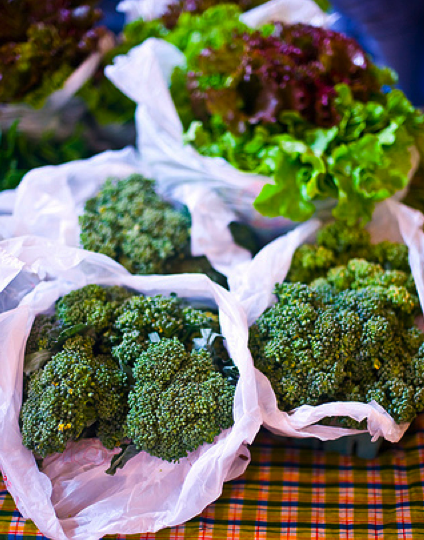
Photo credit Kate NG SommersDeforestation, erosion, deteriorating water supply, acid rain, greenhouse gas emissions, global warming, and more. Is this humane? By the way, humane food isn't wrapped in unecessary plastic, either.
Compassion for People
Humane food shows compassion for both workers and eaters. Here's how:
Workers
Put simply, when food is humanely sourced, the workers get paid a fair price for their work. They are not forced to work without water or breaks, and they are not afraid of being shipped back "home" for expressing an unpopular need or opinion. Humane food is not produced by modern-day slaves. It is not produced by major corporations who hit their quarterly numbers by refusing to pay tomato pickers another penny per pound. When we eat humane food, we risk putting the Coalition of Immokalee Workers (CIW) out of work, in the best possible way.
Humane food does not have to be certified fair trade, Shared Planet, or Whole Trade. But if it isn't, you might want to ask a few questions before you eat it.
Eaters
Humane food is not full of high-fructose corn syrup or empty calories, and humane food is not full of healthy promises it can't keep. In fact, humane food doesn't have to promise anything at all; since it doesn't usually have a package, there's not really a place to print those promises anyway.
Humane food doesn't try to talk us into consuming more calories than we need, either. As Michael Pollan wrote in In Defense of Food:
Since 1980, American farmers have produced an average of 600 more calories per person per day, the price of food has fallen, portion sizes have ballooned, and… we’re eating…at least 300 more calories a day than we consumed in 1985…. Nearly a quarter of these additional calories come from added sugars (and most of that in the form of high-fructose corn syrup); roughly another quarter from added fat (most of it in the form of soybean oil); 46 percent from grains (mostly refined)…. The overwhelming majority of [these added calories] supply lots of energy but very little of anything else.
Humane food doesn't leave us “both overfed and undernourished.”
A Question of Language, or of Knowing What We Want?
The language of the local food scene has become inadequate, if not -- at times -- downright useless. The words local, sustainable, organic, and fair trade (to list just a few) have been co-opted, distorted, overused, and shaken down like a criminal on CSI. I still believe we can have these words back if we want them. But do we? In order to find the words to express what we want, we need to know what we want in the first place.
Greg Reynolds of Riverbend Organic Farm in Delano, MN, has said that "organic certification is a substitute for knowing who's growing your food and how they're growing it." The same is true for "fair trade," "sustainable," "local," and "green." What is it we really want when we use these terms? Do we know, and are we prepared to ask tough questions in order to make sure we get it? Are you?

Lee Zukor is the founder of Simple, Good, and Tasty. E-mail him at lee@simplegoodandtasty.com or follow him on Twitter.


Comments
A comment more about the story itself than the content (because I have no objection to the well-organized and thoughtful examination of the chosen term!): where's the epilogue? Was the restaurant's food "humanely sourced"? Did your friend respond? I know it isn't the point of the article, and perhaps the absence of further reference means it wasn't, but you had a good hook there at the beginning ("will I find a great new place to eat through this article?") - that I felt something was missing at the end shows how good a hook it was.
Great article! Talk about asking the tough questions :-)
Thanks friends! Anon, in answer to your question, the restaurant tells me that they source "all natural, hormone free" meat, some local produce, some "free range" food, and lamb from New Zealand. I'm not confident that they source humanely, unfortunately.
Hello Lee
Thanks for the interesting blog on "Humane Food".
Just a quick clarification: The Minnesota Department of Agriculture does not classify anything you eat or "won't eat" as "local". (I've not seen a legal definition of "local") As you know, we do promote food and other ag products that were grown in our state, under our MN Grown Program. We acknowledge that distinction is limited in scope, but most of the products our direct-marketing Mn Grown members provide are sold "locally" (they are "local foods") by almost anybody's definition. I also think it's likely - at least I'm hopeful - most all of them were "humanely sourced" by your definition as well.
Thanks Brian, I very much appreciate your comment. Please help me understand - are you objecting to my use of the word "classify"? If so, what word would better represent the department's view of "local," at least as it's defined by the terrific MN Grown initiative? According to the site:
The program was created over 20 years ago at the request of specialty crop growers in search of a way to differentiate their produce from what was being shipped in from thousands of miles away. The first Minnesota Grown logo featured the phrase “Tastes 2,000 Miles Fresher”.
This definition sauggests that location is the primary (only?) criteria for getting into the directory. Are there farmers or other businesses located within state bounds that are turned away because of their farming or sourcing practices? Are there requirements aside from location that go into figuring out who can be in the directory?
I'm a big fan and supporter of your work, and I believe that the businesses represented in the directory tend to be smaller, sustainably minded growers. We've debated terms before -- please help me get it right in a way that you feel accurately reflects your charter, your goals, and what peopel can expect when they buy "MN Grown." Please also help me understand where to draw the distinction between MN Grown and the larger goals of the department.
Again, I admire and respect the great work you do. Thanks again for engaging in the discussion. I hope to hear from you soon.
Thanks,
Lee
"Objecting" is a little strong.
You said, "The Minnesota Department of Agriculture classifies all sorts of things I won't eat as local." To me, that suggested that we have some definition or ownership of the term "local" that's inclusive of those products you won't eat. We do not.
It's flattering that you use the term "local" and "Minnesota Grown" interchangeably, but as previously acknowledged (and as you know), the defintion of Minnesota Grown is purely geographic.
I'm not the person to speak to the "larger goals of the department", but that is defined in state statute.
Okay, okay. My point is that "local" means more than one thing these days, and that those who wish to eat sustainable or humane food might want to look for a different term.
Hopefully that's clear and didn't offend you. If it did, it was unintentional and I'm sorry. Thanks again for your comments.
-Lee
Beautifully written and researched article. Very thoughtful and well presented information. You sited many of my favorite sources. But still...the interesting thing for me, is that knowing all that we know about the issues of consuming animals, that "we" still do. There are huge environmental and ethical issues and honestly a very simple answer.
Thanks Susan! Is the answer "raw" by any chance? :-)
Thank you for the thoughtful article on such an important subject.
Eh...you don't have to go that far...
thanks gail, great to hear from you!
Apology not necessary.
I enjoyed your blog, and I understand you were trying to make people think about the definition of local. Shopping for "terms" (including local, humane and sustainable...) can be muddy indeed!
I am not an expert, nor am I in any position to defend or even explain the animal husbandry practices of our MN Grown members or ranchers anywhere. But, I am confident that putting people in direct touch with producers allows them to make educated decisions about what to eat "on their own terms" so to speak.
The definition of the word "Humane" would allow it to be used in the sense Lee has proposed, but it also is a word that has evolved in its perception to seem very left. Some on that left would no doubt feel the word would be misused in describing breeding and raising animals for their meat and other by products. I agree that humane sourcing in all trades is a quality of life issue that, unfortunately, not ALL of us are as concerned or even keen on.
Thanks Kevin,
I hadn't seen it as a "left" thing, but I'm interested in your perspective and I agree with your point. What else might you suggest that didn't seem quite as "loaded"? Mindful food? Thoughtful food? Other ideas?
-Lee
Wow. When did food get so complicated?
The idea of "humanely sourced" is interesting, but I agree with your closing comment. "In order to find the words to express what we want, we need to know what we want in the first place." The more we learn about the food system, the more our wants and needs change. Maybe that's why we have such a difficult time expressing what we want?
By the way, I hope the second question you asked your friend was "Tasty?".
Thanks Jen,
The only reason I was considering the place at all was that my brother in law said it was tasty - that was a given. But lots of things are tasty that I'd prefer not to eat for other reasons. You?
So many potential answers to the question of when food got so complicated. When corn subsidies started? When marketers took over the grocery store? When moms started qworking outside of the home? What do you think?
Thanks for engaging!
-Lee
"Can I be sure that the meat I eat at your restaurant did not come from animals that were tortured?" I aksed.
"No," they replied, every single time.
Hi Lee, are you saying that pasture-raising animals (such as the ones on Cedar Summit, Thousand Hills, Sunshine Harvest Farm) cannot be relied upon as a gauge for humane treatment of animals? I try to eat only meat, eggs and dairy from pastured animals for the very reason that I believe they're being raised humanely, so please tell me if I've been wrong all this time.
Thanks, Nancy
Hi Nancy,
Thanks for asking mer to clarify. Pasture-raised animals from small, local farms I know are what I use as my proxy to determine humanely raised food as well (I'm with you). In the cases above, the people at the restaurants I called did not know where the food was from.
Hope this helps,
Lee
Thank you, Lee, that was a very important point to clarify since your post began from the premise of humanely sourced meat.
Wow. What a loaded question, "Are the animals you serve tortured?" IF I owned a restaurant and got a call like that, I would assume the asker was coming from a totally biased perspective, i.e. that any animal used for agriculture was automatically deemed a victim of torture just by dint of being a part of the agricultural food chain. I would answer yes just because I would believe they were wasting my time and that any answer would necesarily be wrong, sort of like a DA asking me "When did you stop beating your wife?"
To people who follow animal rights doctrine absolutely, ANY animal use is abuse and torture, even the kindest and most gentle humane farm where endangered heritage breeds are kept free range and sang to sleep every night....
I suggest you try Popeyes fried chicken in Watts....or Harlem.. or any other neighborhood where people actually have to work for a living, raise children and pay taxes.. most people do not have the time it takes to do what you are doing.. they are busy trying to stay alive...to wonder if the food they et has been "tortured"..
"high fructose corn syrup" is synthesized in the body exactly like any sugar.. including "organic".. ask any Doctor..
torture is not the same as abuse.. sorry..
Several doctors have approached us, thanking us for our work. They agree that the food choices people make matter, regardless of income. People who work at Popeye's in Watts have the same right to know what's in their food as everyone else, and they are just as caring as the rest of us. It's offensive to suggest otherwise.
Affordability and accessibility are extremely important issues which we continue to cover at SGT, although they are not addressed in this particular article. The issues of knowledge and desire, which are discussed in this article, are important too.
There has always been a certain way to butcher animals for human use. People that don't understand that, have no business making choices on how animals should be butchered. It may not seem to be the way for some of you, but it is the right way. The blood in an animal carries the disease, it has to been pumped out of the body during the death of the animal. It has been that way for thousands of years. Leave it alone!
It is so easy to "look the other way", or take the path of "just not wanting to know" what happens to the animals that are a food source. I had chickens. They were sweet, friendly and some used to accompany me on my chores around the farm. I also had pet pigs. They were smarter than my dogs. My sheep greeted me like a pack of friendly dogs and used to beg to be petted and scratched. No one on my farm was eaten for any reason.
I wish people could experience these animals, and then experience a packing plant (I have). Go and watch the horrors that happen to these gentle animals. Or just pick up a book and read about it.
In this country we are lead to believe that we need way more protein than we actually need. We are lead to believe that our source of calcium should come from dairy (there are better sources). We seem to think that we have some special right to eat animal products, and that we need them.
In truth, this shift has contributed to making us the unhealthiest population on the earth. High levels of obesity, heart disease, cancer and many other degenerative diseases are now directly attributed to our diet. Children are suffering illness and poor health associated to diet at a epidemic level.
As for Popeye's in Watts, look at the Chipotle model. They offer decent food that is "humanely" raised and sustainable. I fear that Popeye's is more a model of corporate profit at the expense of their consumers. It can be done differently, in a more healthy manner for customers and the planet. Chipotle does it, why can't Popeye? And in turn, feed their customers a healthier meal. Don't the people of Watts deserve this?
Everyone should be free to make their own choice. But let it be an educated one. If we continue to look away, ignore what is happening, and make excuses, change, desperately needed change will not occur. Thank you, Lee, for continuing to bring these issues up for thought.
Hi Lee,
I thought this article was outstanding, both in content and delivery. I recently started a humane-food-awareness site that I think largely shares your point-of-view. I came across this article while browsing the web for like-minded content.
I'd like to share with you an article from my site:
http://noshmeat.com/blog/2011/3/20/what-is-shmeat/
I think you might enjoy reading it, as it has a similar perspective, in terms of its focus on humane food. It received more attention than I expected, so I think there is a general feeling that 'humane' does encapsulate all the vague "positives" that people are looking for in their food.
Thanks for your writing, I will be sure to keep up with this site, now that I've found it.
Mu
Thanks Mu, your piece is excellent. Good to know you!
Post new comment